
Marketing Mojo: How to Market Your Business When You Go Green
September 1, 2009
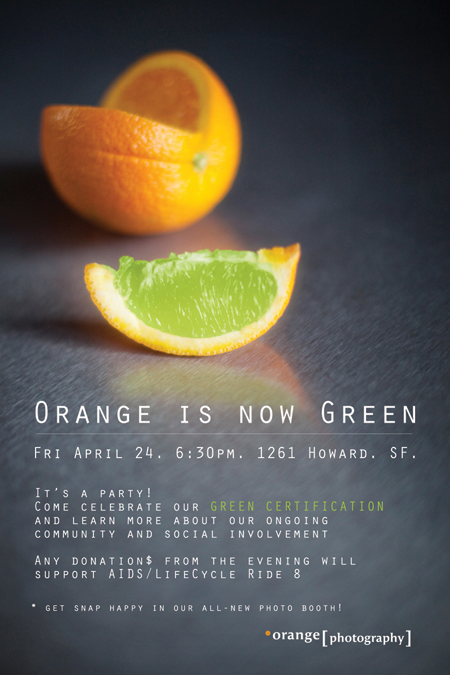
With the growing “go green” trend, you may have begun to investigate avenues for bringing an eco-consciousness to your business. One photo studio that has effectively incorporated environmentally sound practices into its marketing and business plans is Orange Photography, San Francisco’s first photography studio to be part of the city’s Green Business Program. (They recently became officially green certified by the city). Specialists in event photography, wedding photography, executive portraiture and corporate photography since 2001, owners Jack Huynh and Gene X Hwang have “pushed perspectives” for their national and international clientele. Honored by San Francisco Mayor Gavin Newsom, who designated August 27, 2007, as “Orange Photography Day,” they’ve also been named Supplier of the Year by the Northern California Chapter of Meeting Planners International, and earned WPJA awards for wedding photography.
“We’ve always had an eco-focus,” says Gene. “More importantly, one that focuses on social responsibility, which includes our business practices, how we treat our employees, and our social photography program for giving back to our community.”
Here, the Orange Photo owners offer tips for going green:
Be Sincere. Transitioning to green processes and products has to be part of your overall perspective so it won’t appear that you are just hopping on a bandwagon. “People are smart and can see through insincerity, especially if you are marketing your studio one way and operating in a way that directly contradicts that, such as not recycling and composting,” says Gene. “Only pursue a green makeover if it’s something you believe in, if you’re doing it because it reflects values you and your studio hold.”
Do Your Homework. Before aligning yourself with any of the various green organizations that are cropping up, research the green designations and who endorses them. Avoid signing up for a certification simply because someone invites you to sign up with them. “Since green designations are new and there is no national standard, look into local certification programs first. Go to your local city or county Department of the Environment or contact your Chamber of Commerce, which can point you in the right direction,” says Gene. “There are official designations you can earn; they are a great way to get moving in the right direction. These organizations may showcase your business and, of course, are a great place to network too.”
Be Consistent & Thorough. Whatever changes you implement, be thorough and consistent. “Many of our practices and products reflect a long-held eco-conscious perspective,” says Gene, “however, during our ‘green audit,’ when we were being certified by the city and county, we had to modify our business cards and other marketing materials to make them more green. If you work with a green printing partner who offers to print the words ‘made with XX% recycled material’ on marketing materials, say ‘yes.’ Clients who receive your materials will see that your green conscience extends to your promotional materials.”
Expect challenges. The main obstacle to maintaining an eco-conscious perspective for many studios is cost. “Adopting an eco-conscience is more about the real costs of doing business and not something we see as a negative,” says Gene. “By considering the full impact of the decisions we make, it actually feels better to follow a green policy.” Another possible hurdle: clients and prospects resistant to your new perspective. Says Gene, “People in Northern California are very eco-conscious. At worst, they don’t care. At best, they are delighted to be able to work with environmentally conscious vendors and partners.”
Welcome new business and partners. Marketing your studio with an official green designation may attract new business opportunities or partners. “Since the green movement has garnered a lot of momentum in the corporate world, we’ve been able to promote it and our clients love it,” says Gene. “If a client or prospect can get the same quality of service with a ‘green vendor,’ at a competitive price, it’s often enough motivation to push a prospect to that vendor.”
Let the Buyer Beware. Because going green is so trendy these days, be wary of so-called green vendors in the marketplace. “Since many green products aren’t as green as they are advertised to be, we are very vigilant when picking out the best products and services,” says Gene. “This even includes our choice of cleaning products and using towels instead of paper towels in our studio bathrooms.”
Embrace innovation. Be receptive to innovative tools for getting the job done. “One of the highlights of our green certification for the city of San Francisco was going paperless with ShootQ, a studio-management program that helps you streamline workflow, close leads and manage studio bookings. Built by photographers, it integrates merchant services using green payment processors, where some of the money you pay in is actually donated to a charity of your choice. The system automatically sends out reminders for open invoices and helps you track when certain things need to happen. It’s a great way to green your business on the back end, where that’s rarely a real option.”
Watch for Orange Photography’s new website at www.orangephotography.com or check out their blog at https://pulp.orangephotography.com/blog.
Alice B. Miller is the owner of Plum Communications Inc. (www.plumcomm.com), a Long Island, NY-based editorial services and marketing-communications company that supports the photo industry. Formerly editor of Studio Photography magazine, Alice has a growing clientele that includes photographers, manufacturers, publications and associations. She is the director of public relations for the International Photographic Council and an advisory board member of NyghtFalcon photography studios.
Related Articles

Why Felix Kunze Thinks We’ve Been Overcomplicating Lighting (And What He’s Doing About It)
July 24, 2025
When it comes to lighting in photography, most of us instinctively reach for soft, flattering light. We diffuse our flashes, shoot through umbrellas, and seek out cloudy days. But what if I told you that some of the most striking portraitYou know the moment: your subject is ready, you’ve got about five feet of space to work with, and the...
More »

How to Photograph Fireworks for Couples Portraits
October 24, 2024
Fireworks aren’t just for the Fourth of July! You’ll find them regularly at theme parks, sporting events, and maybe more surprisingly, at weddings. For the latter, fireworks offer photographers a wonderful opportunity to capture epic couples portraits with a truly unique backdrop. Of course, if you’re not familiar with how to photograph fireworks, there are some basic tips you’ll want...
More »

Why Top Photographers are Embracing Hard Light (And You Should, Too)
October 23, 2024
When it comes to lighting in photography, most of us instinctively reach for soft, flattering light. We diffuse our flashes, shoot through umbrellas, and seek out cloudy days. But what if I told you that some of the most striking portraits actually come from embracing hard light? That’s exactly what renowned photographer Roberto Valenzuela teaches in his groundbreaking new Dynamic...
More »