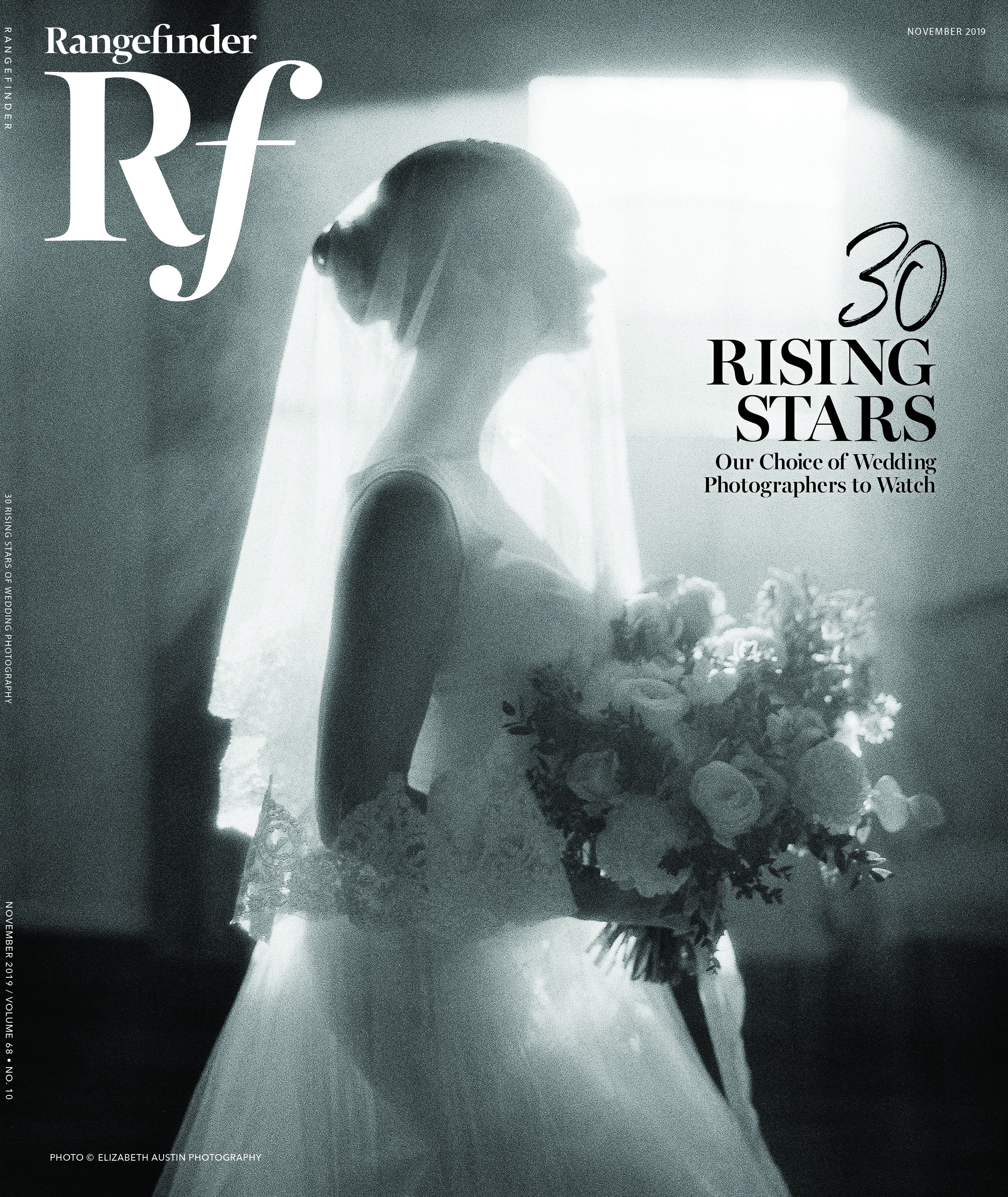
Ultimate Light Box
April 1, 2011
My photographic debut was in an old redbrick neighborhood parish church with a dressing room in the basement filled with toys, mini chairs, tables, stained walls and peeling paint. It was 15 minutes until show time. My mentor that day stood the bride parallel to a plain wall, almost touching her bouffant gown. He angled her shoulders slightly away, then turned and tipped her face back toward her nearest shoulder and the wall. He directed her eyes demurely down into her bouquet held bust high.
He was using a twin-lens Mamiya reflex camera. He swiveled his Honeywell “potato masher” flash on its bracket to bounce the illumination off the wall. To the novice, the whole scenario was mysterious—it took literally 30 seconds.
Much later in the darkroom the magic developed. Literally the softest, most delicate yet directional light I had ever seen. The nursery clutter disappeared in a dim blur. Beautiful delineation of soft skin, rounded with highlight and shadow. A perfect rendition of what I learned later to be Rembrandt lighting. Elegant studio quality achieved without time, equipment, an assistant or a studio.
As much as wedding photography has changed to emphasize natural moments, we still strive to provide elegance, detail and precision. The drive for quantity hardly gives us a moment to set exposure and focus, much less work with sophisticated lighting with our modern, complex equipment.
Yet that’s exactly what the savvy photographer must do to remain lucrative. Brides are becoming reluctant to buy the so-called photojournalistic-style favored by a large percentage of professionals. Quoting the recent PMA Newsletter, “Many of the resulting images do not appear dramatically more ‘professional’ than those made by part-timers and even consumers.”
When the decisive moment happens at a wedding, how do you ensure you get the shot? Today, many photographers use little or no flash, settling for contrasty, blurry or noisy images, and filling a scene with an unrealistic blasts of light.
For lighting inspiration, look through Joe McNally’s new book The Moment it Clicks: Photography secrets from one of the world’s top shooters. Once you’re excited with the genius of light production, grab an Ultimate Light Box and see what it’s all about. It’s really the first total system light modifier for on-camera use.
The ULB doesn’t fall off your camera. Its attachment collar is custom fit to your flash manufacturer and model. The ULB has no Velcro, straps and anything that glues onto your equipment. That alone is worth the $104.95 street price.
Great candid lighting is one major thing few of your competitors—especially novices—can achieve. Magazine and editorial images all share the secret of dimensional lighting, but it’s almost always achieved with multiple lights off camera, assistants, power packs, etc. The common wedding photographer rarely has this kind of budget, time or even personnel to achieve it. The Ultimate Light Box flash modifier (www.harbor digitaldesign.com) has changed the playing field. It provides a fast track to soft directional, natural lighting in a wide range of scenarios on your camera.
You have to be perceptibly different to succeed. Monte Zucker may well have been right. One of his last predictions suggested a cyclical return to the elegance of posing and directional lighting.
You already have to work hard to anticipate key moments and expressions. Your portraits and candids must be totally flattering to earn client dollars these days, because most demand to look like they just stepped out of a magazine.
You are aware of the technical problems: Location lighting is often so low or contrasty that you just can’t get the shot you want in time—and in focus for that matter. And everybody wants mood lighting to be preserved, never overpowered. Take it to the next step and learn and apply the secrets of fashion and editorial illumination with flash. The Ultimate Light Box will lower your learning curve and produce dependable results.
There are three steps to building controlled flash that melds naturally and seamlessly with ambient conditions. The trick is practicing your flexible technique with different parts of the ULB system to meet various wedding and event conditions. Here are the steps:
Step One
Soften and spread the flash: the lowest common denominator in Lighting 101. Get rid of harsh shadows and punchy, greasy-looking complexions. Lots of flash modifiers on the market do this nicely. Before I started working with a ULB, I used the Sto-Fen, the Lightsphere II and the Lumiquest Promax 80-20, and they all have slightly different characteristics and more limited usage.
Step Two
Balance and limit the flash. Previsualization comes in handy here. Do you want the background to blow out to darken with just a hint of detail, or to have equal illumination to the subject? This is all about how you set your camera.
Step Three
This is the hardest but most rewarding step. Here’s where the Ultimate Light Box will become your ally in creating angles, direction and shadows with your flash. Even for party candids the most attractive, flattering light is not omni-directional. Flat light is just flat. Shape, size and texture in pictures bring back the most lively, vibrant wedding memories.
I’m talking the tiny, white-on-white beads on the gown, smooth sliding chiffon or rusty taffeta dresses, and delicate flower petals. How well you light will equal the lasting enjoyment of fine photographs—textural and emotional depth. Brides want to hear the music again, relive the touch of their parents’ hands, and smell the flowers as though they just were placed on the altar. Fine light is not just for weddings. Any portrait, product, trade show, scene, speaker or fashion image benefits from the perspective and planes defined by light.
Put your critical eyes on these examples to see how the Ultimate Light Box works and how it is truly certifiable magic. Dimension in almost any tough to photograph interior space can be achieved with one flash on-camera, vertical or horizontal, using the ULB. It works in a big reception hall or hotel suite. It works in bright or dim ambient lighting, softening and broadening outdoors when you’re not bouncing. It also works softening for baby images. It also allows you to snoot or flag it to further limit light patterns.
Sound too good to be true? That’s what I thought too. But the ULB simply takes every situation in stride; brides, candids, speakers, trade shows, museums, airports and portraits. Yes, you have to work the system, but once you see the light… well, you get the point.
Sara Frances, M.A., is a past winner of Kodak’s Impact in Applied Photography award and has been internationally published. Her studio, Photo Mirage Inc., is located in Denver, Colorado. She is the author of an upcoming book for Amherst Media, Elegant Weddings in Black and White. She can be reached at [email protected].
Related Articles
Why Felix Kunze Thinks We’ve Been Overcomplicating Lighting (And What He’s Doing About It)
July 24, 2025
When it comes to lighting in photography, most of us instinctively reach for soft, flattering light. We diffuse our flashes, shoot through umbrellas, and seek out cloudy days. But what if I told you that some of the most striking portraitYou know the moment: your subject is ready, you’ve got about five feet of space to work with, and the...
More »

How to Photograph Fireworks for Couples Portraits
October 24, 2024
Fireworks aren’t just for the Fourth of July! You’ll find them regularly at theme parks, sporting events, and maybe more surprisingly, at weddings. For the latter, fireworks offer photographers a wonderful opportunity to capture epic couples portraits with a truly unique backdrop. Of course, if you’re not familiar with how to photograph fireworks, there are some basic tips you’ll want...
More »

Why Top Photographers are Embracing Hard Light (And You Should, Too)
October 23, 2024
When it comes to lighting in photography, most of us instinctively reach for soft, flattering light. We diffuse our flashes, shoot through umbrellas, and seek out cloudy days. But what if I told you that some of the most striking portraits actually come from embracing hard light? That’s exactly what renowned photographer Roberto Valenzuela teaches in his groundbreaking new Dynamic...
More »